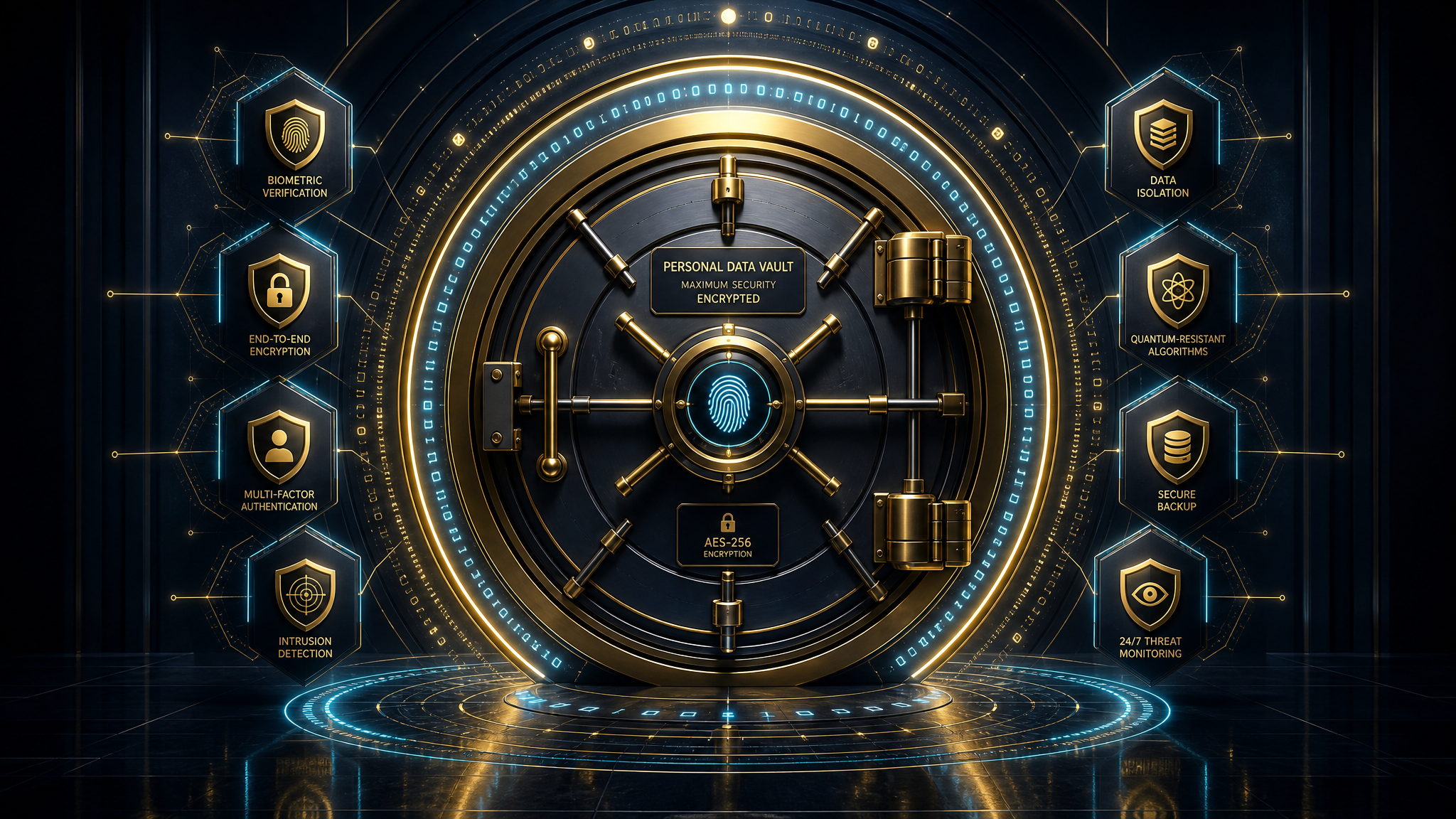
The Asymmetry Nobody Argues With
There is no serious disagreement about the state of personal digital security. A senior executive at a large company sits behind identity federation, device management, network segmentation, encrypted storage, logged access, and a security team whose job is to notice when something is wrong. The same person, at home, on their own accounts, has a password manager if they are diligent and a reused password if they are not.
The interesting question is not why the gap exists. It is why the gap persists after the technology stopped being expensive.
---
What Executive Protection Actually Consists Of
Strip the vendor language away and enterprise-grade security reduces to a small number of architectural decisions.
Assume nothing is trusted. No device, network, or session is trusted because of where it sits. Every request re-proves who is asking and whether they are still allowed. This is zero trust, and it is a design posture, not a product.
Encrypt at rest and in transit, with keys you control. The value is not the cipher. It is who holds the key. If the provider holds it, the provider can be compelled, breached, or acquired.
This is not a product launch. It is a public commitment: the rules that govern how AI agents act on behalf of people should themselves be governed by people.
Log everything, immutably. Detection is impossible without a record. An append-only log that cannot be quietly edited is the difference between knowing what happened and guessing.
Scope every credential, and expire it. Standing access is the largest category of avoidable damage. Access that lapses by default fails safe.
Watch continuously, not annually. The gap between compromise and discovery is where the real loss accumulates.
Every one of those five is a configuration choice. None of them requires a budget. What they require is someone to make them, and to keep making them as circumstances change.
---
Why Individuals Do Not Get Them
Not cost. Attention.
Enterprise security works because it is somebody's full-time job. The controls are not smarter than what an individual could apply. They are simply applied consistently, by a person who is paid to care, on a schedule that does not depend on anyone remembering.
A standard that people fear to touch is a standard that doesn't spread. We want S-ACT everywhere — including in the hands of our competitors.
An individual has no such person. They have a browser with forty tabs, a phone with sixty apps, a decade of accounts they have forgotten, and no inventory of any of it. The failure mode is not ignorance. It is that continuous security work does not fit inside a life.
This is precisely the shape of problem that a governed agent addresses well. Not because an agent is cleverer than a security engineer, but because the work is repetitive, rule-bound, and never finished — the three properties that make delegation worthwhile.
---
What a Personal Guardian Is Designed To Do
A Personal Guardian is an agent operating under an explicit ruleset on behalf of one person. Its remit is narrow and dull by design.
- Maintain an inventory of the accounts, devices, and data stores that actually exist, rather than the ones you remember.
- Apply the five architectural defaults above wherever the person has authority to apply them.
- Notice changes — a new login location, a credential appearing in a breach corpus, a permission quietly widened by an app update — and surface them while they are still cheap to fix.
- Keep an audit record the person can read, so the agent's own behaviour is inspectable.
The last point matters more than the rest. An unaccountable agent with access to your entire digital life is not protection. It is a single point of catastrophic trust. Which is why the governance layer is not an add-on to this idea. It is the idea.
---
Headcount measures enthusiasm, not legitimacy. Governance does not transfer on signatory count.
The Governance Problem Sitting Underneath
Any agent capable of securing your accounts is, by construction, capable of taking them from you. Capability and risk are the same capability viewed from two directions. There is no version of this where you get the benefit without granting the access.
So the question that decides whether personal agent security is a good idea or a terrible one is not how capable the agent is. It is what constrains it.
Five constraints have to be answerable, in writing, before the access is worth granting.
Authority — who authorised this agent, and can that authorisation be shown?
Scope — exactly which systems and data does it reach, and what is explicitly out of bounds?
Data — what does it retain, for how long, and where does that sit?
Audit — is there a record of what it did that the agent itself cannot rewrite?
The race is not to build the biggest AI. It is to build the governance architecture that makes the biggest AI trustworthy.
Revocation — can the person revoke it immediately, unilaterally, without asking the vendor?
An agent that cannot answer all five should not hold your credentials, regardless of how well it performs. This is the same ruleset F-ACT applies to agents operating inside institutions, for the same reason: the failure that matters is not the agent going wrong, it is nobody being able to prove what it did or stop it.
---
The Honest Version of the Claim
It would be easy to say a personal agent makes an individual as secure as a Fortune 500 executive. That is not true, and it will not survive contact with anyone who works in security.
A large organisation has threat intelligence, incident response, legal recourse, insurance, and negotiating power with the platforms it depends on. An individual has none of those, and no agent supplies them.
What is true is narrower and still worth saying. The architectural controls that do most of the work are available to individuals at effectively zero marginal cost, and the only reason they go unapplied is that nobody is doing the applying. Close that gap and you have not achieved parity. You have removed the most embarrassing part of the asymmetry — the part that exists purely because attention is scarce.
That is a smaller claim than the marketing version. It is also one that holds up.
Sources & Further Reading
- 1.S-ACT 1.0 Standard Specification
- 2.S-ACT Patent Non-Assertion Pledge
- 3.Call for Founding Signatories — Consortium
- 4.W3C — Standards Process
- 5.Linux Foundation — Open Governance Model
- 6.United Nations — World Humanitarian Day