Two Exponentials Walk Into a Lab
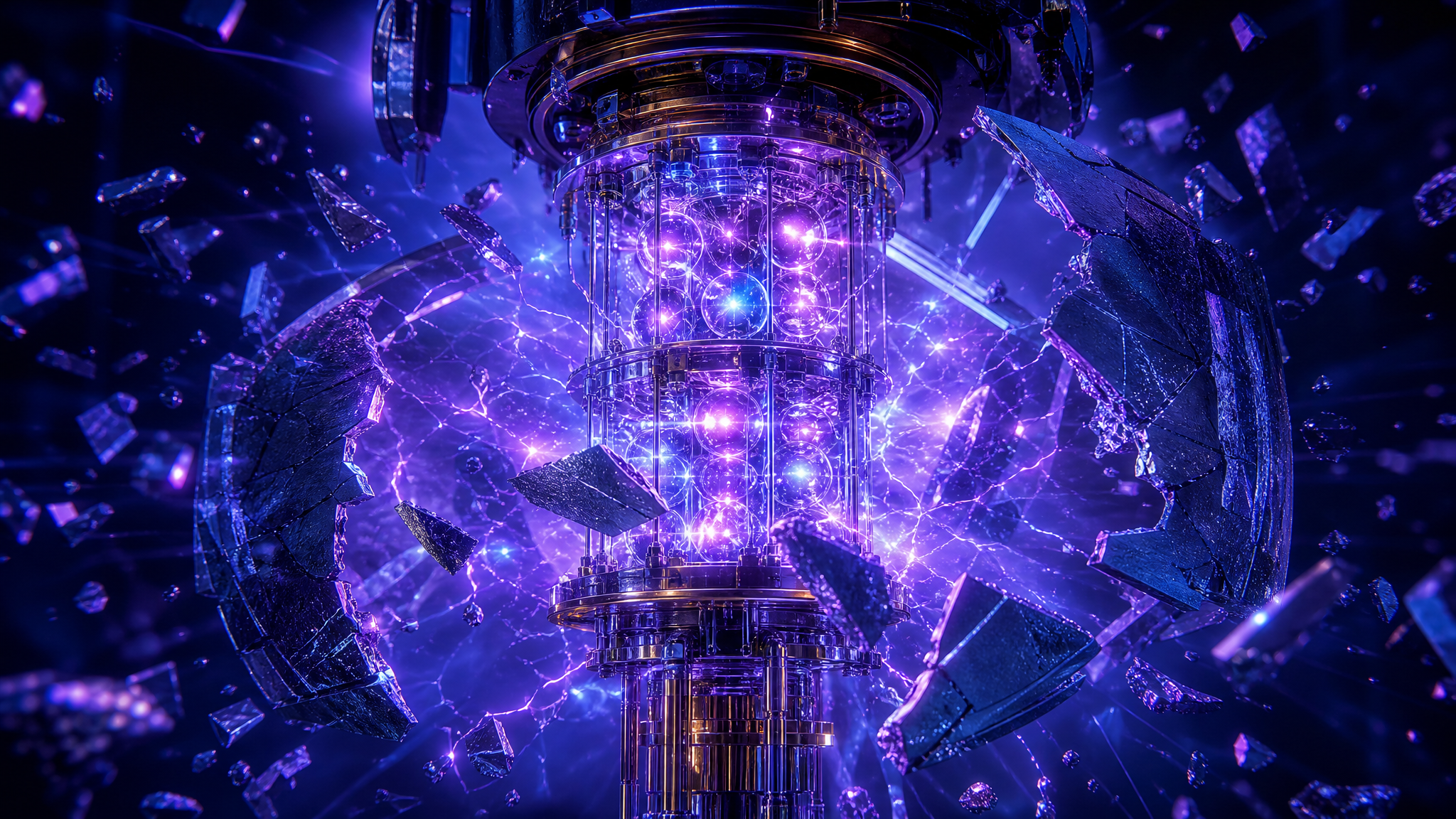
In April 2026, a team at ETH Zurich published a result that would have seemed paradoxical five years earlier. Using a hybrid quantum-classical system, they demonstrated a method for predicting chaotic fluid dynamics — the kind of turbulent, nonlinear behaviour that defeats conventional simulation — that was 20 percent more accurate than the best purely classical approach while requiring significantly less memory. The quantum computer did not solve the problem directly. Instead, it identified stable mathematical structures hidden within the chaos — invariant patterns that a classical AI model could then learn from. The quantum system saw what the classical system could not; the classical system did what the quantum system could not.
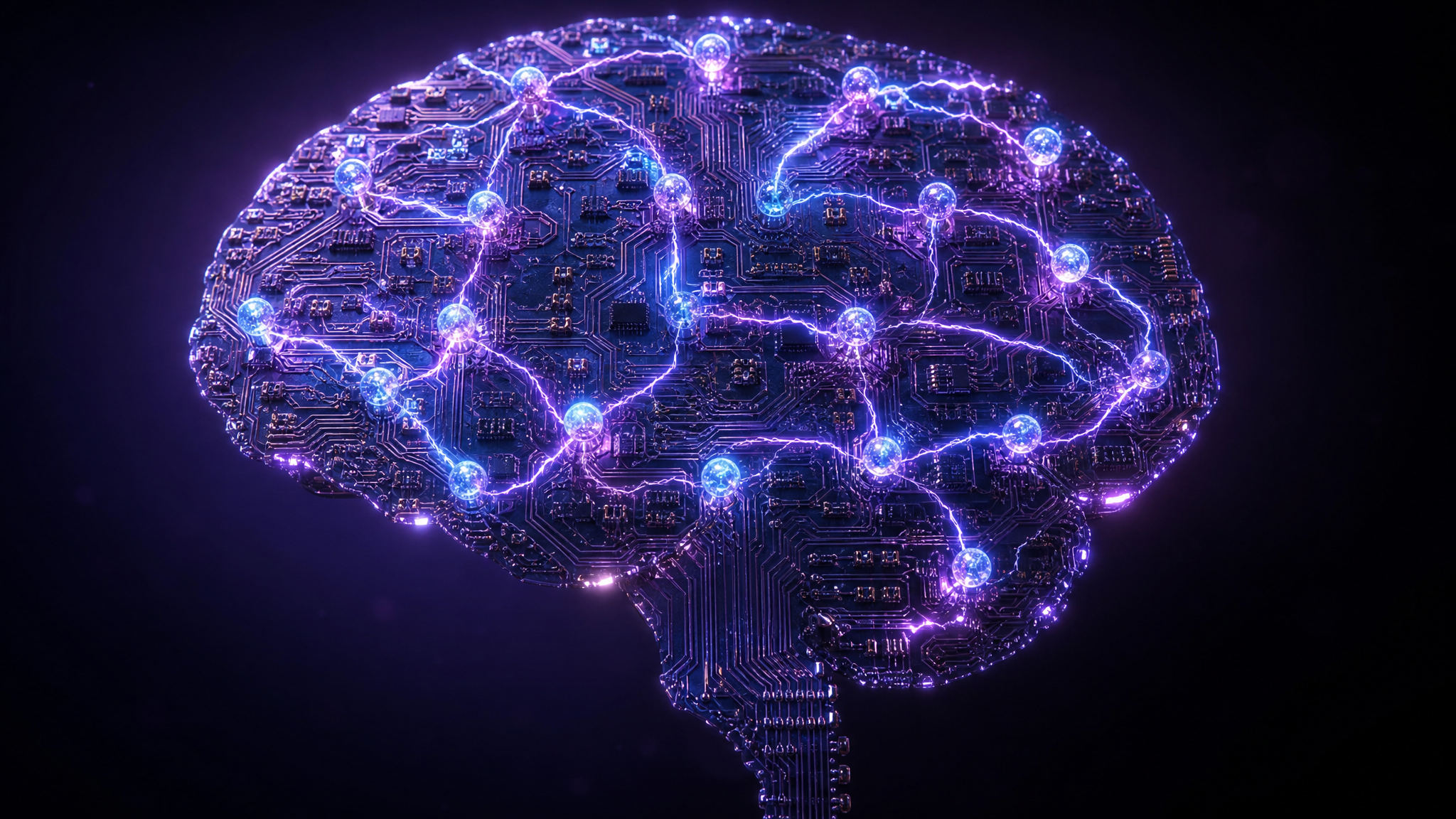
This is the quantum-AI convergence in miniature: not quantum replacing classical, not AI replacing physics, but a symbiosis in which each technology amplifies the other's strengths while compensating for its weaknesses. It is the most powerful partnership in the history of computation, and it is arriving at a moment when the OECD calls it "essential to the next digital revolution" — with $55 billion in global R&D investment behind it and counting.
But the convergence narrative is more nuanced than the press releases suggest. Practical quantum advantage remains narrow, hardware-specific, and domain-constrained. The hype cycle has produced inflated expectations that risk disillusioning investors and policymakers. And the governance frameworks for a technology that combines the opacity of deep learning with the physical complexity of quantum mechanics are, to put it charitably, embryonic.
This article separates what is real from what is aspirational, maps the convergence landscape as it exists in mid-2026, and examines what it means for the governance of technologies whose capabilities exceed our ability to understand them.
The Convergence Architecture
AI for Quantum: The Operating System Layer
The most immediate and least controversial aspect of the convergence is AI's role in making quantum computers work better. Current quantum hardware is noisy, fragile, and extraordinarily difficult to calibrate. Qubits decohere in microseconds. Error rates, while improving, remain orders of magnitude higher than classical computing. Every quantum computation is a race against entropy.
AI has become the essential management layer for this hardware. Machine learning algorithms now perform several critical functions:
Error Mitigation and Decoding. Quantum error correction requires real-time identification and correction of errors faster than new errors accumulate. Classical error-decoding algorithms are too slow for the most advanced quantum processors. AI-driven decoders — trained on the specific noise profiles of individual quantum devices — can identify and correct errors in real time, extending the effective lifetime of logical qubits. Google's Willow chip, which demonstrated below-threshold error correction in December 2024, relied on machine learning models to optimise its decoding strategy.
Hardware Calibration. A modern quantum processor has hundreds of control parameters — microwave pulse shapes, timing sequences, frequency tunings — that must be precisely calibrated for optimal performance. Manual tuning is impractical. Reinforcement learning agents now perform continuous calibration, adjusting parameters in real time to compensate for drift and environmental fluctuations. IBM's quantum systems use automated calibration pipelines that have reduced setup times from days to hours.
The quantum computer saw what the classical system could not; the classical system did what the quantum system could not. This is the convergence in miniature.
Circuit Optimisation. Quantum algorithms are expressed as circuits — sequences of quantum gates applied to qubits. The efficiency of a circuit depends heavily on how it maps onto the physical constraints of the hardware (qubit connectivity, gate fidelities, available gate sets). AI-powered compilers now optimise circuit layouts, reducing gate counts by 20–40 percent compared to hand-optimised designs. This directly translates to fewer errors and longer effective computation times.
Experiment Design. Perhaps most intriguingly, reinforcement learning is being used to discover entirely new quantum experimental protocols. Rather than relying on human physicists to design experiments, AI agents explore the space of possible experimental configurations and identify protocols that human researchers had not considered. A 2025 Nature paper demonstrated AI-designed protocols for preparing quantum states that outperformed the best known human-designed methods.
In each of these applications, AI serves as the operating system of the quantum computer — the layer that translates between the messy reality of physical hardware and the clean abstractions of quantum algorithms. Without AI, current quantum hardware would be largely unusable. The convergence, at this layer, is not optional. It is a prerequisite.
Quantum for AI: The Acceleration Layer
The reverse direction — quantum computing accelerating AI — is more speculative but potentially more transformative. The thesis is straightforward: certain computational tasks central to AI training and inference scale poorly on classical hardware but have natural representations on quantum systems.
Optimisation. Training a neural network is fundamentally an optimisation problem: finding the set of parameters (weights) that minimise a loss function over a training dataset. Classical optimisation algorithms can get trapped in local minima — solutions that are good but not optimal. Quantum optimisation algorithms, including the Quantum Approximate Optimisation Algorithm (QAOA) and quantum annealing, explore the solution space through quantum tunnelling — a physical phenomenon that allows the system to pass through energy barriers rather than climbing over them. In principle, this enables quantum optimisers to find better solutions faster.
In practice, quantum optimisation advantage has been demonstrated only for narrow, structured problems. A 2026 study by researchers at JPMorgan Chase and Quantinuum showed quantum advantage in portfolio optimisation problems with specific correlation structures, but the advantage disappeared for more general problem instances. The honest assessment: quantum optimisation is promising for specific industrial workloads (logistics routing, financial risk, molecular docking) but not yet a general-purpose accelerator for AI training.
Sampling. Generative AI models — from diffusion models to large language models — rely heavily on sampling from complex probability distributions. Quantum systems are natural samplers; the probabilistic nature of quantum mechanics means that a quantum computer can sample from certain distributions exponentially faster than classical hardware. Google's original quantum supremacy demonstration (2019) was precisely this: sampling from a distribution that classical computers could not replicate in feasible time.
The challenge is connecting this sampling advantage to AI workloads that matter commercially. Random circuit sampling (the task demonstrated by Google and others) does not directly correspond to the sampling tasks in generative AI. Bridging this gap — designing quantum algorithms that sample from the specific distributions required by commercial AI models — is an active and intensely competitive research area.
Simulation. The most concrete near-term application of quantum computing to AI is in generating training data for scientific AI models. Classical simulation of quantum systems (molecules, materials, chemical reactions) is exponentially expensive. Quantum simulation is naturally efficient for these problems. By using quantum computers to generate high-accuracy simulation data for molecular interactions, materials properties, or chemical reactions, researchers can train classical AI models on data that would be impossible to generate classically. This "quantum data for classical AI" approach is already in use at pharmaceutical companies including Roche, Merck, and Bristol Myers Squibb.
The Hybrid Architecture: Neither Quantum Nor Classical
The prevailing consensus in the industry by mid-2026 is that the future of advanced computing is heterogeneous. Quantum computers will not replace GPUs or classical supercomputers. Instead, they will function as specialised co-processors within hybrid quantum-HPC (high-performance computing) environments — much as GPUs function as specialised accelerators alongside CPUs.
Without AI, current quantum hardware would be largely unusable. The convergence is not optional. It is a prerequisite.
In these hybrid architectures, the classical system manages the overall workflow: data preprocessing, orchestration, memory management, and post-processing. The quantum processor is invoked for specific computational kernels — tasks that scale poorly on classical hardware but have efficient quantum representations. The classical AI model frames the problem; the quantum processor solves the hard core; the classical system interprets and applies the result.
This architecture has several implications:
The quantum advantage is narrow. The quantum processor accelerates specific subroutines, not entire workflows. The overall speedup depends on what fraction of the total computation can be offloaded to quantum hardware — an application of Amdahl's Law to the quantum context.
Integration is the bottleneck. The technical challenge is not building better quantum hardware (though that remains essential) but efficiently interfacing quantum and classical systems. Data must be encoded into quantum states, processed, measured, and decoded back into classical representations. Each translation step introduces latency and potential errors. The "quantum bandwidth" — the rate at which useful quantum computations can be performed and integrated into classical workflows — is the practical limiting factor.
Software is the moat. As quantum hardware becomes more commoditised, competitive advantage shifts to the software layer: the algorithms that decompose problems into classical and quantum components, the compilers that optimise quantum circuits for specific hardware, and the AI models that manage the hybrid workflow. Companies investing in quantum-AI software stacks — including Google (Cirq/TensorFlow Quantum), IBM (Qiskit), and startups like Algorithmiq, Classiq, and Zapata Computing — are positioning for this shift.
Where Quantum-AI Is Real Today
Drug Discovery and Materials Science
The most advanced commercial application of quantum-AI convergence is in molecular simulation for drug discovery and materials science. Here, the quantum advantage is physically grounded: molecules are quantum systems, and simulating them on quantum hardware eliminates the approximations required by classical methods.
Google's Willow chip has been used to calculate molecular ground-state energies for small drug-relevant molecules with chemical accuracy — errors below 1 kcal/mol, the threshold required for reliable drug design predictions. While Willow's 105 qubits cannot yet handle the largest drug candidates (which may require thousands of logical qubits), the demonstration establishes the pathway.
Algorithmiq, one of the winners of the WEF's Quantum for Society challenge, has developed the Aurora platform — a software layer that enables pharmaceutical researchers to extract maximum accuracy from current-generation quantum hardware. Aurora uses error mitigation techniques (many of them AI-driven) to compensate for hardware noise, effectively increasing the useful computation that can be extracted from noisy intermediate-scale quantum (NISQ) devices.
The Cleveland Clinic-IBM partnership, launched in 2023 and expanded in 2025, represents perhaps the most ambitious clinical application: using quantum-AI hybrid systems to screen potential drug candidates for Alzheimer's disease, targeting protein-ligand interactions that are intractable on classical hardware.
Financial Services
A quantum-AI hybrid system produces decisions that emerge from two layers of inscrutability — a recommendation whose basis cannot be fully explained to anyone.
Financial institutions have been early adopters of quantum-AI for optimisation and risk management. JPMorgan Chase has published extensively on quantum approaches to portfolio optimisation, derivative pricing, and fraud detection. Goldman Sachs has explored quantum Monte Carlo methods for risk analysis. HSBC has partnered with IBM to investigate quantum approaches to anti-money laundering.
The financial use case is compelling because the value of even marginal improvements is enormous. A portfolio optimisation algorithm that is 2 percent more efficient than its classical counterpart can generate hundreds of millions of dollars in additional returns across a large institutional portfolio. Financial institutions are willing to invest in quantum-AI infrastructure because the economic threshold for "useful quantum advantage" is lower in finance than in almost any other domain.
Climate and Energy
Quantum-AI is being applied to climate science and energy optimisation through several channels. Quantum simulation of catalytic processes could accelerate the discovery of more efficient catalysts for carbon capture, hydrogen production, and battery chemistry. Quantum optimisation is being tested for power grid management — balancing supply and demand across renewable energy networks with complex, time-varying constraints.
Nomad Atomics, another WEF Quantum for Society winner, uses quantum gravimeters — quantum sensors rather than quantum computers — to monitor underground CO₂ migration for carbon capture and storage projects. This represents the often-overlooked "quantum sensing" dimension of the convergence: quantum technology applied not as computation but as measurement, providing data that AI models then interpret.
The Brain Chain: The Talent Bottleneck
As of late 2025, The Quantum Insider identified the limiting factor for quantum industrialisation as the "brain chain" — the scarcity of specialised talent capable of managing the integration of quantum, classical, and AI systems. This is not merely a shortage of quantum physicists. The convergence requires a new kind of professional who understands quantum algorithms, classical AI/ML, hardware constraints, and domain-specific applications simultaneously.
The OECD's November 2025 survey of national quantum strategies found that 18 OECD member countries and the EU have adopted formal national quantum strategies, with talent development identified as a top-three priority in every strategy. Yet the pipeline remains thin. The number of PhD graduates in quantum information science globally is estimated at fewer than 2,000 per year, against projected industry demand of 10,000–15,000 annually by 2028.
This talent bottleneck has strategic implications. Nations and companies that solve the talent problem will dominate the convergence economy. Those that do not will be dependent on foreign expertise for what is increasingly recognised as critical infrastructure.
The Governance Gap
When Two Opacities Combine
AI is already criticised for opacity — the "black box" problem of deep learning models whose decisions cannot be fully explained. Quantum computing introduces a second layer of opacity: quantum states cannot be directly observed without destroying them, and quantum computations do not produce the intermediate results that enable classical debugging.
The limiting factor for quantum industrialisation is the 'brain chain' — fewer than 2,000 PhD graduates per year against projected demand of 10,000–15,000.
When AI and quantum computing converge, the two opacities compound. A quantum-AI hybrid system might produce a drug candidate recommendation based on quantum molecular simulations processed through a neural network. Neither the quantum computation nor the neural network inference is fully interpretable. The result is a decision that emerges from two layers of inscrutability — a recommendation whose basis cannot be fully explained to a regulator, a physician, or a patient.
This double opacity challenges every governance framework predicated on transparency and explainability. The EU AI Act's requirements for high-risk systems include "sufficient transparency to enable users to interpret the system's output" (Article 13). How does one interpret the output of a system that combines quantum mechanical uncertainty with neural network opacity?
The Security Dimension
The convergence has a darker side. The same quantum computing capabilities that accelerate drug discovery also threaten to break the encryption that protects global communications. As quantum hardware matures, the "harvest now, decrypt later" campaigns — where adversaries collect encrypted data today for decryption by future quantum computers — become increasingly urgent.
The convergence accelerates this timeline. AI-driven error correction makes quantum computers more reliable. Quantum-AI hybrid algorithms reduce the qubit requirements for cryptographic attacks. Each advance in the convergence brings Q-Day closer, even as it delivers genuine scientific and economic benefits.
Post-quantum cryptography (PQC) standards, finalised by NIST in August 2024, provide the technical solution. But migration to PQC is a massive undertaking — every system that uses public-key cryptography must be upgraded. The OECD notes that most national quantum strategies identify PQC migration as critical but few have established binding timelines or enforcement mechanisms.
Society OS and the Quantum-AI Convergence
The quantum-AI convergence creates capabilities that exceed human comprehension in two dimensions simultaneously. Governing these capabilities requires frameworks that go beyond human-scale oversight.
The 42 Pillars: A Constitutional Framework for Dual-Opacity Systems
Society OS's 42 Pillars of Existence provide a constitutional framework that does not depend on understanding how a system works but instead defines what boundaries it must respect. This is a crucial distinction for quantum-AI hybrid systems. If a drug recommendation emerges from two layers of inscrutability, the governance question is not "explain your reasoning" (which may be physically impossible) but "did you operate within the constitutional boundaries defined by the relevant Pillars?"
The health sovereignty pillar, for example, defines boundaries around patient consent, equitable access, and the precautionary principle. A quantum-AI drug discovery system operating within Society OS governance is constitutionally required to respect these boundaries regardless of the opacity of its internal computations. The governance attaches to the boundary, not the mechanism.
Dark Mesh Consensus: Trust for Quantum-Enhanced Systems
Two exponentials walked into a lab. What walks out will determine whether the quantum-AI convergence serves humanity or merely serves those with the resources to harness it.
Quantum computing's inherent security properties — particularly quantum key distribution and quantum random number generation — can strengthen the trust infrastructure that governance requires. Society OS's Dark Mesh Consensus mechanism can incorporate quantum-generated randomness for consensus processes that are provably unpredictable and unmanipulable, creating a governance layer with cryptographic guarantees that classical systems cannot provide.
Simultaneously, Society OS mandates quantum-resistant cryptographic standards for its Universal Sovereign Identity (USI) framework, ensuring that the identity infrastructure that underpins agent governance remains secure even as quantum computing matures. The convergence is thus both a threat (to existing cryptography) and an opportunity (for stronger governance infrastructure), and Society OS is architected to exploit the opportunity while mitigating the threat.
Foundry Swarms: Governed Innovation
Society OS's Foundry Swarms provide the institutional framework for quantum-AI research governance. Foundries ensure that quantum-AI capabilities developed within the ecosystem meet constitutional standards before deployment. This includes:
- Dual-opacity auditing protocols that evaluate quantum-AI systems against SAFE-VOID boundaries without requiring full interpretability of internal computations.
- Equitable access mandates ensuring that quantum-AI breakthroughs (particularly in healthcare and climate) are not monopolised by the organisations that can afford quantum hardware.
- Security review processes that evaluate whether quantum-AI capabilities create new attack surfaces or accelerate existing threats.
The Foundry model addresses the talent bottleneck by creating institutional frameworks that distribute quantum-AI expertise across the ecosystem rather than concentrating it in a handful of well-funded labs.
The Partnership That Changes Everything
The quantum-AI convergence is neither the revolution that press releases promise nor the disappointment that sceptics predict. It is something more interesting: a genuine paradigm shift that is arriving incrementally, domain by domain, application by application, and faster in some areas (molecular simulation, financial optimisation) than others (general AI training, natural language processing).
The OECD is right to call it the most powerful partnership for the next digital revolution. The $55 billion in global R&D investment is, if anything, insufficient for the scale of the opportunity. But the partnership produces capabilities that compound two existing governance challenges — AI opacity and quantum inscrutability — into something qualitatively harder to govern than either alone.
The nations, institutions, and frameworks that solve this governance puzzle will shape the trajectory of computation for the rest of the century. Those that do not will be subject to it.
Two exponentials walked into a lab. What walks out will determine whether the quantum-AI convergence serves humanity or merely serves those with the resources to harness it. The partnership changes everything. The question is: for whom?
This article is part of the Sovereign Intelligence Hub's quantum series. For the cryptographic threat, see [Q-Day Is Closer Than You Think](/hub/q-day-is-closer-than-you-think). For quantum sustainability applications, see [The Quantum Sustainability Startups](/hub/the-quantum-sustainability-startups-the-wef-just-endorsed). For the full threat matrix, see [The Quantum-AI Threat Matrix](/hub/the-quantum-ai-threat-matrix).
Sources & Further Reading
- 1.OECD — 'An Overview of National Strategies and Policies for Quantum Technologies' (November 2025)
- 2.Google Quantum AI — Willow Processor: Below-Threshold Error Correction (December 2024)
- 3.The Quantum Insider — 'Predictions for the Quantum Industry in 2026' (December 2025)
- 4.ScienceDaily — 'Quantum-Informed AI Outperforms Classical Models in Predicting Chaos' (April 2026)
- 5.IBM — Quantum Development Roadmap: Condor, Flamingo, and Starling Systems
- 6.Algorithmiq — Aurora Platform for Quantum-Enhanced Drug Discovery
- 7.NIST — Post-Quantum Cryptography Standards (FIPS 203, 204, 205), August 2024
- 8.European Parliament — EU AI Act, Regulation 2024/1689, Article 13 (Transparency)
- 9.Society OS — Sovereign Singularity Thesis: Existence in the Age of Artificial Minds
- 10.Society OS — 42 Pillars of Existence: The Constitutional Framework
- 11.Society OS — Sovereign Digital Civilisation: The Architecture of a Post-National Future