The Architecture After Transformers
Every era of artificial intelligence has been defined by an architecture. The 1960s had perceptrons. The 1990s had convolutional neural networks. The 2010s had recurrent networks. And since 2017, the transformer — the architecture introduced in Google's "Attention Is All You Need" paper — has dominated so thoroughly that it became synonymous with AI itself. GPT, Claude, Gemini, Llama — every frontier model that shapes the current AI landscape is, at its core, a transformer.
Transformers scale by brute force. More parameters. More compute. More data. More energy. The architecture's genius is its simplicity: self-attention mechanisms that allow every element in a sequence to attend to every other element, creating a universal pattern-matching engine that improves predictably with scale. This predictability — captured in the "scaling laws" that have guided AI development since 2020 — has enabled the extraordinary capability gains of the past five years.
But brute force has limits. Training Grok 4 is estimated to have generated over 72,000 tonnes of CO₂ equivalent. The cost of training a frontier model has exceeded $1 billion. Data centre power capacity has reached 29.6 gigawatts — equivalent to the peak demand of New York State. And there are growing indications that the scaling curve is beginning to flatten, with each doubling of compute producing smaller incremental improvements in capability.
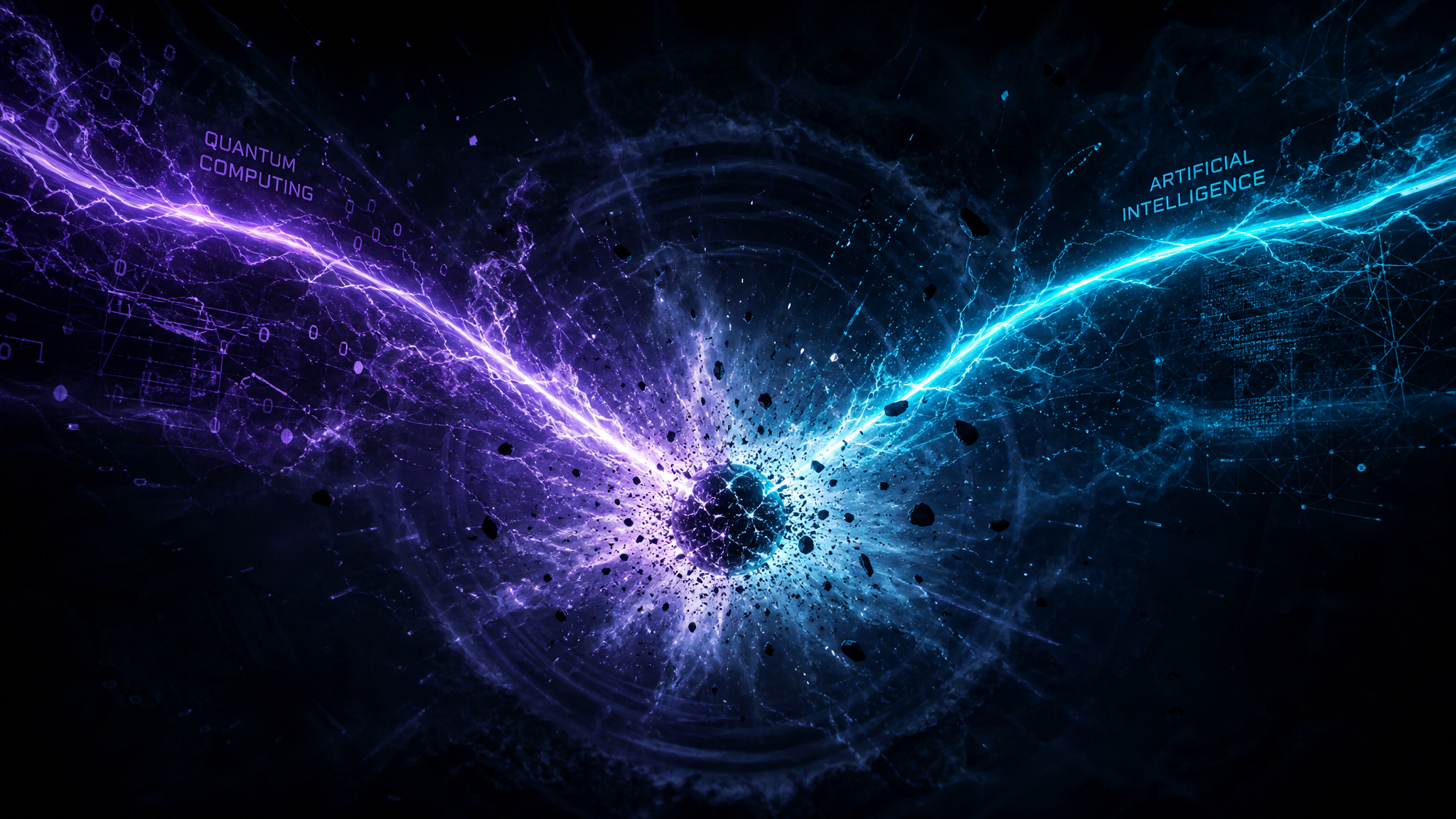
Quantum Neural Networks (QNNs) represent a fundamentally different approach. Rather than scaling classical computation to ever-larger magnitudes, QNNs exploit the unique properties of quantum mechanics — superposition, entanglement, and interference — to process information in ways that are not merely faster than classical computation but categorically different. The question is not whether QNNs can do what transformers do more efficiently. It is whether QNNs can do things that transformers cannot do at all.
Quantum Computing for the Non-Physicist: What You Need to Know
Before diving into QNN architectures, a brief explanation of the quantum properties that make them possible:
Superposition: Being Multiple Things at Once
A classical bit is either 0 or 1. A quantum bit (qubit) can be in a superposition of both states simultaneously. This is not uncertainty — the qubit is not "either 0 or 1, and we don't know which." It is genuinely in both states at once, described by a complex amplitude for each state. When you measure the qubit, the superposition collapses to one definite state, but before measurement, the qubit carries information about both possibilities.
For neural networks, superposition means that a quantum circuit can process multiple inputs simultaneously. Where a classical neural network evaluates one input configuration at a time, a quantum neural network can evaluate many configurations in a single pass through the circuit.
Entanglement: Correlated Without Communication
Two qubits can be entangled such that measuring one instantly determines the state of the other, regardless of the distance between them. This correlation is not due to hidden information — it is a fundamental property of quantum mechanics with no classical analogue.
For neural networks, entanglement enables a kind of implicit parallelism that goes beyond mere multitasking. Entangled qubits in a quantum circuit create correlations between features that classical networks can only approximate through deeper architectures and more parameters. A 10-qubit entangled system can represent correlations across 1,024 states simultaneously.
QNNs don't just do what transformers do faster. They do things transformers cannot do at all — operating natively in feature spaces that are provably inaccessible to classical computation.
Interference: Amplifying Right Answers
Quantum interference allows probability amplitudes to add constructively (amplifying correct solutions) or destructively (cancelling incorrect ones). This is the mechanism by which quantum algorithms extract useful results from the exponentially large space of quantum states.
For neural networks, interference provides a natural mechanism for feature selection and optimisation — the quantum analogue of what classical networks achieve through gradient descent, but operating natively in exponentially large feature spaces.
How Quantum Neural Networks Actually Work
A QNN, in its most common implementation, is a hybrid quantum-classical architecture consisting of three stages:
Stage 1: Encoding (Classical → Quantum)
Classical data is encoded into quantum states through a process called "quantum feature mapping." This is the quantum equivalent of preparing input data for a classical neural network. Common encoding methods include:
- Angle encoding: Classical values are mapped to rotation angles applied to qubits. A single qubit can encode one classical feature as a rotation.
- Amplitude encoding: Classical data is encoded in the amplitudes of a quantum state. This is exponentially efficient — n qubits can encode 2ⁿ classical values — but requires O(2ⁿ) operations to prepare, creating an input bottleneck.
- Basis encoding: Binary classical data is directly mapped to computational basis states of qubits.
The choice of encoding method significantly affects the QNN's performance and is an active area of research.
Stage 2: Processing (Variational Quantum Circuit)
The core of the QNN is a parameterised quantum circuit — a sequence of quantum gates whose parameters are adjusted during training. These gates apply rotations and entangling operations to the encoded qubits, transforming the quantum state in ways that (ideally) extract useful features from the data.
The circuit's architecture — called the "ansatz" — determines its expressiveness. Common ansatze include:
- Hardware-efficient ansatz: Uses the native gate set of the quantum hardware, minimising circuit depth and noise.
- Problem-inspired ansatz: Designed to reflect the structure of the problem being solved, such as molecular symmetries for chemistry applications.
- Layered ansatz: Alternates between single-qubit rotations and entangling gates in repeated layers, analogous to layers in a classical neural network.
Stage 3: Measurement and Classical Post-Processing
A 10-qubit entangled system can represent correlations across 1,024 states simultaneously. A 50-qubit system: over one quadrillion.
The quantum state is measured, collapsing it to a classical bit string. Because quantum measurement is probabilistic, the circuit is typically run multiple times ("shots") to build up statistics. These measurement results are then processed by a classical optimiser that adjusts the quantum circuit's parameters to minimise a loss function — exactly as gradient descent adjusts weights in a classical neural network.
This hybrid loop — quantum forward pass, classical parameter update — is the standard training procedure for variational QNNs. The quantum circuit handles the computation that (in theory) benefits from quantum effects, while the classical optimiser handles the parameter update that currently runs more efficiently on classical hardware.
The Race to Quantum Advantage in AI
Three major players are competing to demonstrate that QNNs can outperform classical neural networks on practical tasks:
IBM: Gate-Model Quantum ML
IBM's approach to quantum machine learning is built on its superconducting qubit hardware (currently the 1,121-qubit Condor processor) and the Qiskit software ecosystem. IBM's Qiskit Machine Learning library provides tools for building quantum classifiers, quantum kernel methods, and hybrid quantum-classical models.
IBM's most notable published result in quantum ML is a demonstration that QNNs achieved 97.8% accuracy on the MNIST-4 dataset (a simplified version of the handwritten digit classification benchmark) using 40% fewer parameters than classical convolutional neural networks. While this is not a demonstration of quantum advantage — classical networks can match or exceed this accuracy — it suggests that QNNs can achieve comparable performance with more compact representations.
IBM's research on "effective dimension" has shown that quantum models can exhibit higher effective dimensionality than classical models with comparable parameter counts, suggesting that QNNs may be able to fit complex data distributions with fewer trainable parameters. This has implications for problems where data is scarce and overfitting is a concern.
Google Quantum AI: Cirq and Beyond
Google's Quantum AI team, which achieved the first claim of quantum supremacy in 2019 with its 53-qubit Sycamore processor, has been advancing quantum ML research through its Cirq framework. Google's approach emphasises quantum feature maps — methods for encoding classical data into quantum states that create feature spaces inaccessible to classical algorithms.
Google's research has focused on identifying the conditions under which quantum advantage in ML is theoretically possible. Their work on "quantum kernel methods" has shown that for certain carefully constructed data distributions, quantum kernels can classify data that no classical kernel can separate efficiently. The challenge is demonstrating that such distributions arise naturally in real-world problems rather than being artificially constructed to favour quantum methods.
Google's Willow processor, with improved error rates and longer coherence times, represents the hardware trajectory needed to make practical QNN applications viable. The key metric is not qubit count but "useful qubits" — qubits with sufficiently low error rates and long enough coherence times to perform meaningful computation before noise overwhelms the signal.
Xanadu: Photonic Quantum ML
Xanadu takes a fundamentally different hardware approach, using photonic quantum computing — circuits based on photons of light rather than superconducting circuits. Photonic systems operate at room temperature (unlike superconducting systems, which require dilution refrigerators), which could significantly reduce the cost and complexity of quantum hardware.
IBM's QNNs achieved 97.8% accuracy on MNIST-4 using 40% fewer parameters than classical CNNs — the same answer with a radically smaller question.
Xanadu's Borealis processor has been used for photonic QNN experiments in molecular chemistry, where it reportedly outperformed traditional Density Functional Theory (DFT) methods for predicting molecular energies. Xanadu's PennyLane software framework — a differentiable programming library for quantum computing that integrates with TensorFlow and PyTorch — has become one of the most widely used tools for quantum ML research.
Xanadu's photonic approach has a particular advantage for continuous-variable quantum computing, which is well-suited to problems involving continuous data distributions — a category that includes many practical ML applications.
The Challenges: Why QNNs Aren't Ready Yet
Despite promising results, QNNs face several fundamental challenges that prevent them from replacing classical neural networks in the near term:
Barren Plateaus: The Training Problem
The most significant theoretical challenge is the "barren plateau" phenomenon. In variational quantum circuits, the loss landscape can become exponentially flat as the number of qubits increases, making gradient-based optimisation essentially impossible. This is the quantum analogue of the vanishing gradient problem in classical deep learning, but potentially more severe because it may be an intrinsic property of random quantum circuits rather than a function of architecture choice.
Research has identified partial solutions — local cost functions, problem-inspired ansatze, and layerwise training strategies — but no general solution to barren plateaus exists. This means that scaling QNNs to the sizes needed for practical advantage may require fundamental algorithmic innovation, not just bigger hardware.
Hardware Noise: The Fidelity Problem
Current quantum hardware operates in the "noisy intermediate-scale quantum" (NISQ) era, characterised by gate error rates typically exceeding 10⁻³. At these error rates, the quantum signal is rapidly overwhelmed by noise as circuit depth increases. Error mitigation techniques — zero-noise extrapolation, probabilistic error cancellation, and symmetry-based verification — can partially compensate, but they impose significant computational overhead.
Full quantum error correction, which would solve the noise problem by encoding logical qubits in multiple physical qubits, requires hardware that is roughly 1,000 times larger than current systems. This threshold is approaching but likely remains 5-10 years away for the most optimistic hardware roadmaps.
Data Encoding: The Input Bottleneck
The most compact quantum encoding method — amplitude encoding, which stores 2ⁿ classical values in n qubits — requires O(2ⁿ) operations to prepare. This encoding bottleneck means that the theoretical exponential advantage of quantum processing may be offset by an exponential cost of loading classical data into the quantum computer. Alternative encoding methods (angle encoding, basis encoding) avoid the bottleneck but require more qubits and provide less compression.
Benchmark Fairness: The Comparison Problem
Many reported demonstrations of QNN performance compare quantum circuits against classical networks that have not been optimised for the specific task. When classical baselines are carefully tuned, the quantum advantage often disappears. This "unfair benchmarking" problem makes it difficult to assess genuine quantum advantage and has led to scepticism about published QNN results.
A nation that achieves quantum advantage in AI gains capabilities that non-quantum nations cannot match or even understand. This asymmetry is qualitatively different from the classical AI gap.
Where QNNs Will Matter First
The consensus among quantum computing researchers is that QNNs will not replace classical neural networks wholesale. Instead, they will serve as specialised co-processors for problems where quantum effects provide a genuine advantage:
Molecular Simulation and Drug Discovery
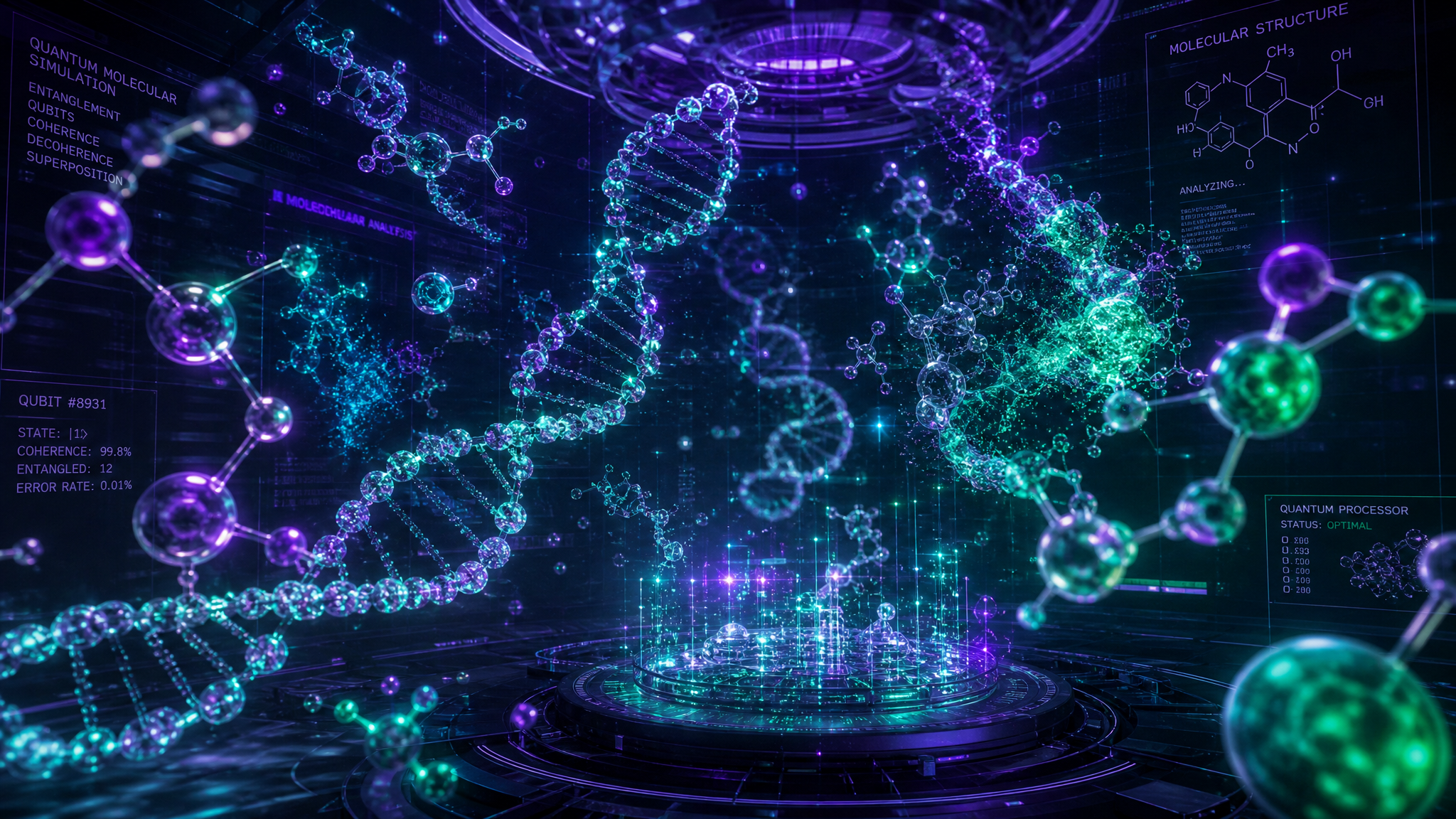
The most natural application of QNNs is simulating quantum systems — molecules, materials, and chemical reactions that are themselves governed by quantum mechanics. Classical simulation of quantum systems is fundamentally limited: the computational cost grows exponentially with system size. QNNs could perform these simulations natively, potentially accelerating drug discovery, catalyst design, and materials science by orders of magnitude.
Combinatorial Optimisation
Problems like supply chain optimisation, portfolio construction, and logistics routing involve searching over exponentially large solution spaces. Quantum algorithms (particularly quantum approximate optimisation, or QAOA) may provide speedups for certain classes of these problems, and QNNs could be used to learn effective quantum optimisation strategies.
Anomaly Detection in High-Dimensional Data
QNNs' ability to operate natively in exponentially large feature spaces may provide advantages for detecting subtle anomalies in high-dimensional data — a task relevant to cybersecurity, financial fraud detection, and scientific data analysis.
The Society OS Perspective: Quantum Sovereignty
The emergence of QNNs adds a new dimension to Society OS's governance framework. Quantum computing capability is even more concentrated than classical AI capability — only a handful of organisations worldwide can build and operate quantum processors — and the potential for quantum advantage in AI creates a new axis of technological asymmetry.
The Sovereign Stack framework, designed to ensure that nations and communities maintain AI autonomy, must expand to encompass quantum computing infrastructure. A nation that achieves quantum advantage in AI could gain capabilities — in drug discovery, cryptanalysis, materials science, and optimisation — that non-quantum nations cannot match or even understand. This asymmetry is qualitatively different from the classical AI gap because quantum advantage, where it exists, is provably inaccessible to classical computation regardless of scale.
The 42 Pillars of Existence include provisions for what Society OS terms "computational sovereignty" — the right of nations and communities to access the computational infrastructure necessary for self-determination. As QNNs begin to deliver practical advantages, computational sovereignty will increasingly require quantum access, adding urgency to the development of quantum infrastructure beyond the current concentration in the US, China, and a handful of European labs.
The H-T-A Protocol must also adapt to the quantum era. Alignment verification for classical AI systems relies on inspecting model weights, activation patterns, and training data — all of which are classical objects that can be examined with classical tools. Quantum neural networks operate in Hilbert spaces that are fundamentally inaccessible to classical inspection. Verifying the alignment of a QNN requires quantum verification tools that do not yet exist, creating a governance gap that must be addressed before QNNs are deployed in high-stakes applications.
The SAFE-VOID boundaries are particularly relevant for quantum AI applications. A QNN with genuine quantum advantage in cryptanalysis could break encryption systems that protect critical infrastructure, financial systems, and personal communications. This capability falls squarely within VOID territory under Society OS's framework, requiring that quantum cryptanalytic capabilities be subject to the strictest governance constraints — structural boundaries that cannot be overridden by commercial or military imperatives.
The race to build quantum neural networks isn't just corporate competition. It's a race to define the next era of artificial intelligence.
The Timeline: When Does This Matter?
Near-Term (2026-2028)
QNNs remain primarily a research tool. Practical applications are limited to niche domains (molecular simulation, specific optimisation problems) where quantum effects provide demonstrable value. Most ML workloads continue to run more efficiently on classical hardware.
Medium-Term (2028-2032)
As quantum hardware reaches the 1,000+ logical qubit range and error rates fall below the threshold for useful error correction, QNNs begin to deliver practical advantages in drug discovery, materials science, and financial optimisation. Hybrid classical-quantum architectures become standard for organisations with access to quantum hardware.
Long-Term (2032+)
Fault-tolerant quantum computers enable QNNs of sufficient scale to tackle problems that are genuinely intractable for classical systems. The relationship between classical and quantum AI becomes complementary: classical systems handle tasks that benefit from scale and data volume; quantum systems handle tasks that benefit from access to exponentially large feature spaces and native quantum simulation.
Whether this timeline proves accurate depends on hardware development trajectories that are inherently uncertain. Quantum computing has a history of promising more than it delivers on timelines shorter than reality requires. But the fundamental physics is sound, the engineering challenges are well-understood, and the investment is accelerating. The question is not whether QNNs will matter but when — and whether governance frameworks will be ready when they do.
Conclusion: The Architecture After Attention
The transformer architecture transformed AI by providing a universal, scalable framework for processing sequential data. Its limitations — quadratic computational cost, purely classical information processing, brute-force scaling — are not bugs but fundamental features of a classical architecture operating within classical physical constraints.
Quantum Neural Networks represent the possibility of a paradigm shift comparable to the transition from perceptrons to deep learning or from recurrent networks to transformers. Not an incremental improvement within the existing paradigm, but a categorical expansion of what neural networks can do by expanding the physical substrate on which they operate.
The race between IBM, Google, and Xanadu is not merely a corporate competition. It is a race to define the next era of artificial intelligence — one in which the boundaries of computation are set not by the economics of scale but by the laws of quantum mechanics. The winner doesn't just build a better model. They redefine what AI can do.
And the governance frameworks we build today — or fail to build — will determine whether that redefinition serves humanity or further concentrates the power of the few entities with the resources to operate at the quantum frontier.
This article is part of the Sovereign Intelligence Hub's quantum computing series. For how QNNs transform drug discovery, see [Quantum Drug Discovery](/hub/quantum-ai-drug-discovery). For the broader quantum-AI convergence landscape, see [Quantum-AI Convergence](/hub/quantum-ai-convergence). For the security implications of quantum computation, see [The Quantum-AI Threat Matrix](/hub/quantum-ai-cryptanalysis-threat).
Sources & Further Reading
- 1.IBM Quantum: Quantum Neural Network Power and Effective Dimension Research
- 2.The Quantum Insider: What Is Quantum Machine Learning? 2026 Overview
- 3.Xanadu PennyLane: Differentiable Programming for Quantum Computing
- 4.Google Quantum AI: Cirq Framework and Quantum Feature Maps
- 5.Quantum Physics-Informed Neural Networks (QPINNs) for Solving PDEs, arXiv 2025
- 6.Medium: Quantum Neural Networks — Advantages and Challenges, 2025
- 7.Stanford HAI AI Index 2026: AI Environmental Impact and Compute Trends
- 8.Vaswani et al., 'Attention Is All You Need', NeurIPS 2017
- 9.Society OS: Sovereign Stack — Architecture for AI-Era National Infrastructure
- 10.Society OS: H-T-A Protocol — Alignment Verification in the Quantum Era
- 11.Society OS: SAFE-VOID Boundaries for Quantum AI Applications